


Wilkerr Research & Fieldwork
Big Desert Dingo Research conducts long-term field monitoring and contributes to scientific research focused on Wilkerr, the genetically distinct and geographically isolated dingo population of the Big Desert-Wyperfeld region.
Our work includes camera trapping, population monitoring, genetic sampling, behavioural observations and collaboration with researchers, Traditional Owners, universities and government agencies. These partnerships help build a clearer understanding of Wilkerr population size, social structure, movement, ecology and the threats affecting their long-term survival.

In-Depth Evaluation of Wilkerr Population Estimates
We are pleased to announce the release of our new study, now available as a preprint, which provides an estimated population size for the local Wilkerr population. Our findings indicate an estimate of 77 adult Wilkerr, with a 95% credible interval ranging from 64 to 94. This research, conducted in collaboration with Deakin University, has been submitted for peer review and publication. You can read the full study here: https://ecoevorxiv.org/repository/view/10200/
Scouting the ideal location for world-renowned cinematographer.
This project was an exciting opportunity to help capture the first high-definition footage of Big Desert dingoes / Wilkerr. Working alongside Dr Daniel Hunter, a highly skilled cinematographer, and Dingo Coexistence, who commissioned the project, we scouted the perfect location. We beat the harsh Mallee heat by waking up at 3.30 am each day. Resulting in this divine footage of one of our favourite Big Desert dingoes / Wilkerr we call 'the old boy' (aka Sneezy). The footage aired on ABC's 7.30 report, which provided a professional platform to showcase the behaviour and habitat of these fascinating creatures.
In the field with Deakin University
Our ongoing collaboration with Deakin University, which officially began in mid-2023, focuses on extensive trail camera fieldwork across the Big Desert and Wyperfeld National Park. We currently manage more than 60 cameras to monitor the Big Desert dingo / Wilkerr population, social structures, and movement patterns. The time-lapse footage captured offers a rare and compelling window into the hunting behaviour of Big Desert dingoes / Wilkerr, highlighting the depth of insight this research is uncovering.
In July 2024, highlights from this collaboration were presented by Deakin University Research Fellow, Amanda Lo Casio, at the 70th Australian Mammal Society Scientific Meeting. We are proud to contribute to such meaningful research and look forward to sharing our findings through peer-reviewed publications that will help guide future conservation policy.


In April 2022, we volunteered with Deakin University to assist PhD student Rachel Mason in the field as part of her study, Assessing target and non-target species interactions with buried non-toxic meat baits across fire mosaics. Our role involved helping to set up camera traps and bury non-toxic baits across the Big Desert/Wyperfeld, contributing to data collection that aimed to better understand how various species interact with baits in the landscape.
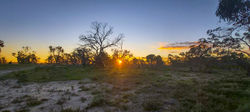
Although we didn’t encounter any dingoes / Wilkerr during this fieldwork, we found plenty of fresh dingo / Wilkerr tracks, a reassuring sign of their ongoing presence in the area. The experience also gave us our first glimpse of Milmed Rock, and we were treated to a spectacular desert sunset. These moments reinforced the deep connection we feel with this remarkable environment.
It was a privilege to support Rachel’s research. Collaborations like this help build a stronger understanding of predator behaviour and improve conservation and management strategies.
 |  |  |
|---|---|---|
 |  |  |
 |  |  |
 |
Stop the press!
Throughout the years, Leesh has been featured in numerous news publications. Below are a few links to select articles showcasing these interviews.
Call for answers after poison found buried in rare predator's habitat
by Michael Dahlstrom, Yahoo News
by Samantha Smith, Wimmera Mallee News
Better protection for Victoria's Dingoes being sought by advocates
By John Hall, The Wimmera Mail-Times
Local dingo advocate applauds Victoria's new policy protecting Aussie icon
By John Hall, The Wimmera Mail-Times
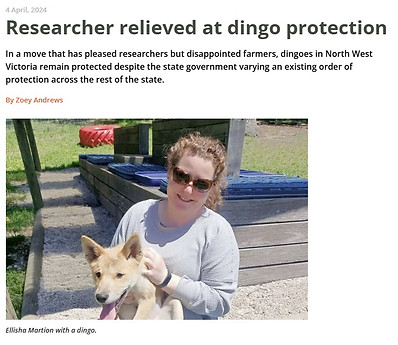
Researcher relieved at dingo protection
By Zoey Andrews, Wimmera Mallee News
By Ellisha Martion, The Weekly Advertiser
By Zoey Andrews, Wimmera Mallee News
Wimmera farmers urged to protect livestock while honouring dingo laws